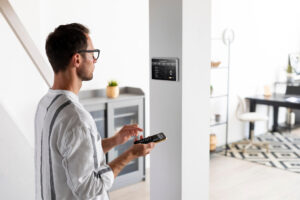
Homes have steadily moved from detached living spaces into responsive situations where gadgets associated with one another in ways that expand past straightforward control. Lights alter naturally, temperature frameworks react to inhabitance, and security highlights work persistently without coordinate input. These changes are not disconnected advancements but portion of a broader framework where mechanization coordinating ordinary capacities into facilitated processes.
The nearness of savvy domestic frameworks presents a diverse relationship between tenants and their environment. Assignments that once required manual activity gotten to be implanted inside modified groupings or versatile reactions. This move changes how time, vitality, and consideration are disseminated inside day by day schedules. At the same time, the foundation supporting robotization must handle changeability in behavior, network, and framework performance.
Smart domestic mechanization works through a combination of equipment gadgets, communication conventions, and program rationale. Together, these components make a organize where activities are activated, information is traded, and frameworks alter in reaction to changing conditions. The coming about environment reflects both innovative capability and designs of ordinary living, forming how residential spaces work over time.
One automation that looks straightforward from the outside can actually pass through a few separate steps. A sensor notices a condition, its reading reaches another device or controller, automation logic checks the rule, and only after this another device performs the action. When the expected action does not happen, knowing these stages makes it easier to see that the final device is not continuously the part creating the problem.
This is especially visible in connected homes where manual control can still work while automation fails. A light that switches correctly from an application but does not react toward a motion sensor gives a different condition from a light that cannot be controlled at all.
Device Integration and Interconnected Systems
Smart domestic situations depend on the integration of numerous gadgets that perform particular capacities however work inside a shared framework. Lighting frameworks, indoor regulators, machines, and security components interface through centralized stages or dispersed systems. This integration permits gadgets to communicate, empowering facilitated behavior or maybe than confined operation.
Compatibility plays a critical part in how successfully gadgets connected. Distinctive producers may utilize shifting communication measures, which can impact how consistently frameworks coordinated. Stages that bolster numerous conventions offer assistance bridge these contrasts, permitting for broader interoperability.
Compatibility can exist at more than one level. Two devices may use a compatible communication technology while still lacking the software function required for one to control the other. Network connection and functional integration are therefore not continuously the same thing.
A useful check is to separate whether the device is powered, connected, visible to the platform, reporting its state, and accepting commands. These conditions can look similar from the user side when something stops working but they point toward different portions of the system.
The interaction between gadgets makes layers of usefulness. A movement sensor may trigger lighting, alter temperature settings, and actuate security notices at the same time. These intuitive reflect the complexity of coordinates frameworks, where person components contribute to a bigger operational framework.
One sensor can consequently become a shared dependency. If its readings become unavailable, several automations can stop or behave differently even though the lights, climate equipment, and notification service themselves remain functional.
Communication Conventions and Arrange Architecture
Underlying savvy domestic mechanization is a organize engineering that encourages communication between gadgets. Conventions such as Wi-Fi, Zigbee, and Bluetooth empower information trade, each advertising unmistakable characteristics in terms of extend, speed, and vitality utilization. The choice of convention impacts framework execution and reliability.
Network structure decides how gadgets interface and associated. A few frameworks depend on centralized center points that oversee communication, whereas others utilize decentralized approaches where gadgets communicate specifically. Each structure presents distinctive contemplations for adaptability and resilience.
The path used by one command can matter when troubleshooting. A local switch may communicate directly toward one device, while a mobile application can depend on Wi-Fi, an internet connection, a cloud service, and then the home system. One path can fail while another continues working.
This produces a useful difference between local and remote operation. If control works inside the home but fails from outside, the device itself may still be operating normally while the external connection or cloud portion is unavailable.
Signal quality and obstructions influence communication stream inside the arrange. Physical boundaries, gadget thickness, and outside signals can impact network, forming how viably mechanization forms work in genuine time.
Intermittent communication can be more difficult to notice than complete disconnection. A device that misses only some commands can create an automation that appears unreliable rather than fully broken. Comparing missed actions with connection or device logs can show whether these events happen together.
Automation Rationale and Rule-Based Triggers
Automation inside savvy homes is administered by rationale that characterizes how and when activities happen. Rule-based frameworks permit for predefined triggers, such as time plans or sensor inputs, that start particular reactions. These rules make unsurprising designs of behavior inside the domestic environment.
More progressed frameworks join conditional rationale, where different variables impact results. For illustration, lighting may alter based on both time of day and inhabitance, making more nuanced reactions. This layered rationale increments adaptability but too presents complexity in framework design.
A rule can be separated into trigger, conditions, and action. Motion can provide the trigger, time of day can act as one condition, and switching a light can be the action. If the trigger happened but the condition was not satisfied, no final action may be the correct behavior rather than a failure.
Looking at these stages prevents every missing action from being treated as a device problem. A changed schedule, disabled rule, different sensor state, or another condition can stop the same automation before any command reaches the final device.
Automation rationale must account for changeability in day by day schedules. Settled plans may not continuously adjust with genuine behavior, requiring frameworks to adjust or join extra inputs to keep up relevance.
Rules can also conflict. One automation may turn lighting on after motion while another time-based rule turns it off shortly afterward. Each rule can operate exactly as configured while the combined result appears unexpected to the person inside the room.
Data Collection and Natural Sensing
Smart domestic frameworks depend on information collected from sensors that screen conditions such as temperature, movement, stickiness, and light levels. This information gives the establishment for computerized reactions, empowering frameworks to alter based on real-time information.
The precision and situation of sensors impact the quality of information collected. Destitute situating can lead to deficient or deluding data, influencing how frameworks react. Reliable information collection underpins more solid computerization outcomes.
Sensor location can change what the system believes about the same room. A temperature sensor close toward direct sunlight, a heating source, an exterior wall, or a frequently opened door can report conditions that do not represent the wider occupied area.
Motion sensing creates another limitation because absence of detected movement is not continuously equal to absence of a person. Somebody sitting quietly can produce a different signal pattern from somebody walking through the same room.
Environmental detecting expands past quick conditions. Authentic information can be analyzed to recognize designs, permitting frameworks to expect changes and alter proactively. This capability upgrades the responsiveness of computerization frameworks over time.
Historical information becomes more useful when gaps are visible. A sudden flat line or missing section can indicate loss of reporting rather than a real environmental condition that remained perfectly unchanged.
Versatile Behavior, Machine Learning, and Framework Evolution
Smart domestic computerization progressively consolidates versatile components that expand past settled rules. Machine learning calculations analyze designs in client behavior, natural conditions, and framework execution to refine how computerization works. These frameworks move from responsive reactions toward more expectant behavior, altering settings based on deduced inclinations and trends.
Google Nest, developed in Mountain View, California, uses smart home technology that combines sensors, usage patterns, and automated adjustments to manage household environments. Devices such as smart thermostats analyze activity and temperature changes to adapt settings based on conditions inside the home.
The Nest example gives one visible difference between a fixed schedule and an adaptive system. A fixed schedule follows the times entered into it until somebody changes them. An adaptive system can use observed activity and conditions as additional input, meaning later behavior can differ even when a person did not manually rewrite every setting.
This also means unexpected behavior needs to be examined beside learned or adaptive settings. The question is not only whether a thermostat received a command, but what information caused the system to choose that command.
Adaptive frameworks handle expansive volumes of information produced through day by day intuitive. This information incorporates utilization designs, sensor readings, and gadget movement logs. By distinguishing relationships and repeating arrangements, frameworks can alter mechanization rationale without express programming. For occurrence, lighting designs may advance to adjust with watched schedules, or climate control frameworks may alter based on inhabitance trends.
The quality of this adaptation depends on the pattern represented in the data. Temporary changes in routine, visitors, holidays, unusual working hours, or a sensor moved into another location can produce information different from the household’s ordinary behavior.
The advancement of these frameworks presents a move in how control is dispersed. Or maybe than depending exclusively on predefined enlightening, computerization gets to be in part independent, competent of altering its claim parameters. This independence requires cautious adjusting to guarantee that framework behavior remains steady with anticipated results whereas adjusting to variability.
Manual override remains useful in this situation. A person may want a different temperature or lighting condition without permanently changing the broader automation. The way a system treats temporary override versus a new long-term preference influences what happens afterward.
Feedback circles play a basic part in versatile behavior. Frameworks ceaselessly assess the comes about of their activities, comparing them against anticipated conditions. Inconsistencies lead to alterations that refine future reactions. This iterative prepare contributes to progressive framework advancement over time.
A feedback loop can also expose a bad input. If a temperature reading is incorrect, the control system can continue making adjustments that are logical according to that reading while producing a poor real-world result. Correct logic cannot compensate for every incorrect sensor value.
The integration of machine learning moreover influences framework complexity. As calculations ended up more advanced, the basic forms that drive mechanization ended up less straightforward. This murkiness can impact how frameworks are checked and overseen, especially when unforeseen behavior occurs.
Logs, history views, and explanation of recent actions become useful when automation is not obvious. Seeing that a temperature change followed a schedule, occupancy event, manual command, or adaptive decision can make the system easier to understand without needing to expose every internal calculation.
Data protection and security contemplations gotten to be more unmistakable as versatile frameworks depend on broad information collection. The capacity and handling of behavioral information require shields to avoid unauthorized get to and abuse. These contemplations impact how frameworks are outlined and implemented.
Household data can reveal more than one device state. Repeated occupancy, door, lighting, and temperature patterns can indirectly show when a home is normally occupied or empty. The usefulness of historical data therefore exists beside a privacy reason for controlling who can reach it.
Adaptive computerization expands to intelligent between gadgets. Frameworks can facilitate different components based on learned designs, making more cohesive reactions. For illustration, lighting, climate, and amusement frameworks may alter at the same time to coordinate watched inclinations amid particular times of day.
The advancement of savvy domestic frameworks reflects broader patterns in innovation, where robotization gets to be progressively data-driven and responsive. This movement reshapes the relationship between clients and their situations, presenting modern flow in how residential spaces operate.
Energy Administration and Proficiency Dynamics
Smart domestic mechanization impacts vitality utilization by altering frameworks based on real-time conditions and utilization designs. Lighting and climate control frameworks can decrease vitality utilize by working as it were when required, reacting to inhabitance and natural factors.
Energy administration includes adjusting consolation with effectiveness. Computerized alterations must keep up craved conditions whereas minimizing superfluous utilization. This adjust is impacted by framework plan and the precision of information inputs.
Energy reduction should be compared against a useful baseline rather than assumed from the presence of automation alone. A smart device can still use more energy when its schedule or control rule causes equipment to operate longer than necessary.
Heating and cooling give a clear example because setpoint, outdoor conditions, occupancy, insulation, and operating time can all change energy consumption. A lower monthly number after an automation change does not by itself prove which one of these factors produced the difference.
The integration of vitality observing devices gives understanding into utilization designs. These apparatuses permit frameworks to recognize wasteful aspects and alter operations appropriately, contributing to more economical vitality utilize inside the home.
Time-based energy information can show whether consumption actually changes when an automation activates. This gives a stronger comparison than looking only at one total bill where weather and other household activity are mixed together.
Security Frameworks and Get to Control
Security highlights inside keen homes work as interconnected frameworks that screen and control get to. Cameras, sensors, and shrewd locks work together to identify movement and oversee passage focuses. These frameworks give ceaseless oversight, regularly joining with versatile gadgets for farther monitoring.
Access control components characterize how section is allowed or limited. Verification strategies may incorporate computerized accreditations, biometric information, or proximity-based frameworks. These components impact how security is kept up without disturbing every day routines.
Remote access expands convenience but also extends the path that needs protection. Account credentials, mobile devices, cloud services, network communication, and the smart-home device can all participate in one remote command.
Removing an old user from a household also needs attention toward credentials or permissions that remain active. Changing who lives in or has access toward the home does not automatically remove every digital access method unless the platform does so.
The interaction between security frameworks and other mechanization components makes coordinates reactions. For case, lighting may actuate when movement is recognized, or alarms may be activated based on unordinary movement patterns.
Security automation should also consider what happens during internet or power loss. A smart lock or alarm function that depends on an external service can require local or backup behavior so basic operation does not disappear only because one connection becomes unavailable.
User Interfacing and Interaction Models
Smart domestic frameworks are gotten to through interfacing that permit clients to screen and control gadgets. These interfacing incorporate portable applications, voice collaborators, and physical controls implanted inside the domestic. Each interface gives a diverse mode of interaction.
The plan of these interfacing influences ease of use and availability. Clear introduction of data and natural controls bolster proficient interaction, whereas complex or divided interfacing can prevent framework effectiveness.
The interface can also hide the actual route of a command. Pressing one button in an application can appear direct even when the request passes through several network and service layers before reaching the device.
This matters during failure because an application message such as offline does not always identify which connection in that path became unavailable. Comparing physical control, local application control, and remote control can narrow the part of the system involved.
Interaction models shift in their level of coordinate control. A few frameworks emphasize manual input, whereas others depend on mechanization to decrease the require for client mediation. The adjust between these approaches shapes the by and large encounter of keen domestic environments.
Physical controls remain useful even inside highly automated environments. Visitors, children, service workers, or household members without application access may still need a direct and understandable way to control ordinary functions.
Reliability, Upkeep, and Framework Stability
The execution of shrewd domestic frameworks depends on their unwavering quality and capacity to keep up steady operation. Network issues, equipment disappointments, and computer program overhauls can all impact framework behavior. Guaranteeing steady execution requires progressing support and monitoring.
A useful reliability check separates complete failure from intermittent failure. A device that never responds is easier to recognize, while one that fails one command from ten can produce an automation problem that appears random.
Timing can help here. If several different devices become unavailable during the same periods, a shared network, hub, power source, or outside service becomes more relevant than several independent device failures occurring at once.
System solidness is impacted by the interaction between components. Disappointments in one portion of the framework can influence others, especially in exceedingly coordinates situations. Repetition and fallback components offer assistance relieve these impacts, keeping up usefulness beneath shifting conditions.
Fallback behavior should be considered before failure rather than only after it occurs. A heating system, light, lock, or another important household function can benefit from a local control method that remains usable when automation is unavailable.
Maintenance contemplations expand to both equipment and computer program. Gadgets must be overhauled and overseen to guarantee compatibility and security, reflecting the advancing nature of shrewd domestic systems.
Updates can sometimes alter behavior even when they improve security or add features. Checking automation rules, permissions, device visibility, and integrations after a major platform or firmware change can reveal whether an existing relationship was affected.
Integration with Outside Administrations and Ecosystems
Smart domestic mechanization regularly amplifies past the domestic itself, interfacing with outside administrations and stages. Cloud-based frameworks empower inaccessible get to, information capacity, and integration with broader biological systems such as vitality frameworks or benefit providers.
These integrative grow the capabilities of savvy domestic frameworks, permitting for more comprehensive usefulness. For illustration, climate information may impact climate control, or outside security administrations may upgrade checking capabilities.
An outside integration introduces a dependency that sits beyond the physical home. The local devices can remain powered and connected while an automation relying on weather data, cloud processing, or another external API stops receiving the information it needs.
This gives another troubleshooting split. If local automations continue but only an outside-service automation fails, replacing the local sensor or device may not address the actual condition.
The interaction with outside frameworks presents extra conditions. Network and benefit accessibility impact how successfully these integrative work, forming the in general execution of the keen domestic environment.
External services can also change independently from the home installation. Authentication changes, discontinued integrations, service outages, or modified permissions can affect an automation that previously operated for a long period without local hardware changing.
Technical Review and Sources
The savvy domestic environment examined here is considered through device condition, communication, automation logic, sensor information, adaptive behavior, energy monitoring, security, user control, reliability, and outside service dependencies. Looking at these layers separately offer assistance show why one failed automation does not continuously mean that the final device itself has failed.
Google Nest is utilized as the real-world adaptive home example because smart thermostats and related home technology combine sensor information, user interaction, schedules, and automated adjustment. Claims particular to Nest behavior ought to remain connected to official Google Nest documentation because exact features can differ between device generations and software versions.
Broader explanations concerning Wi-Fi, Zigbee, Bluetooth, sensors, automation rules, local control, cloud dependencies, and connected-device security describe common smart-home relationships. Exact behavior depends on the platform, protocol, hardware generation, and how each household configured its system.
Last technical review: September 2026
References
Google Nest. Thermostat, home automation, and device support documentation.
Google Home. Automation and connected-device documentation.
Connectivity Standards Alliance. Zigbee and connected-home technical information.
Bluetooth SIG. Bluetooth technology and connected-device resources.
National Institute of Standards and Technology. Consumer Internet of Things cybersecurity guidance.